
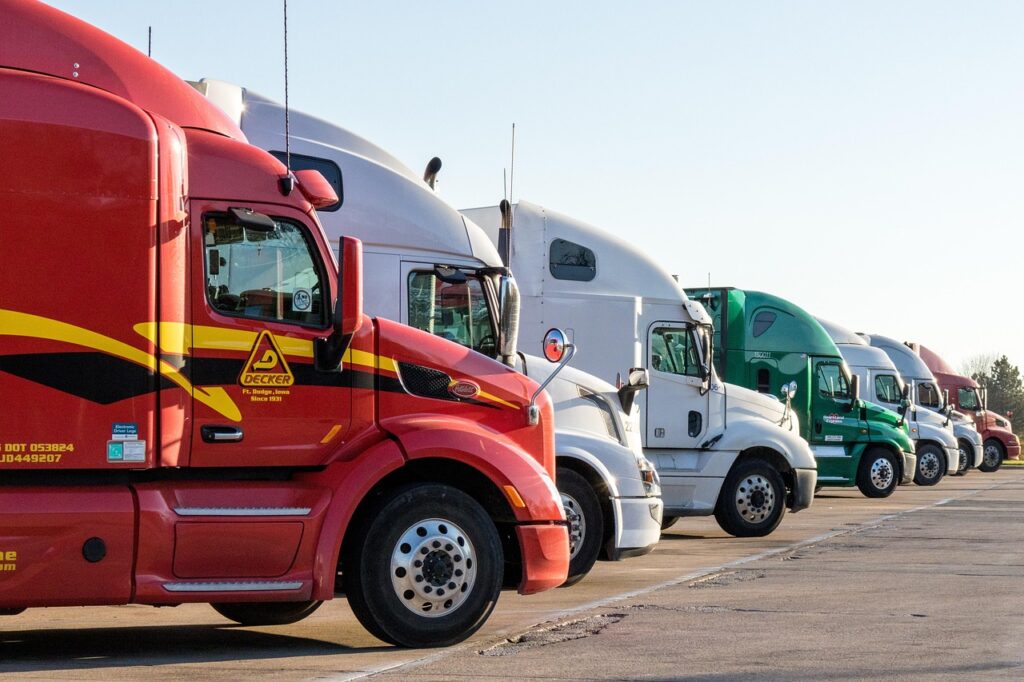
The American Trucking Associations (ATA) proposed establishing an export manifest in Mexico to the White House Trade Representative (USTR).
Truck-transported trade relies heavily on the Mexican trucking industry, particularly drayage companies and their operators, to move goods across the border in both directions. Without these services, cross-border flow would come to a halt.
This is because U.S. drivers generally do not want to enter Mexico. Therefore, in most cases, a Mexican operator crosses into the United States with a loaded trailer and transports it to a terminal located in the border area.
Subsequently, that same driver leaves the trailer at the U.S. company’s terminal and picks up another load or an empty trailer to return to Mexico. Thus, Mexican fleets sustain the operational continuity of binational land transport.
Export manifest
The ATA proposed the adoption of an export manifest in a letter to the USTR as part of the USMCA review. The proposal seeks to strengthen control over cross-border operations.
An export manifest is an official document that records detailed information about goods leaving a country. It includes data on the exporter, carrier, destination, and cargo.
It also allows customs authorities to control, verify, and track international trade operations.
However, in some cases, upon arrival at the terminal, the Mexican driver is instructed to park their truck and use a US vehicle to transport cargo point-to-point within the United States. These operators usually have a B-1 visa, which does not authorize domestic transport.
Once the goods are unloaded on US territory, especially outside the border area, they are considered domestic cargo. This practice, known as cabotage, involves US companies hiring foreign drivers without work authorization to perform domestic transportation and, in some cases, multiple trips before returning to Mexico.
Mexican drivers
Cabotage laws seek to protect drivers and companies that comply with regulations from unfair competition. However, some carriers employ operators with B-1 visas to pay lower wages and avoid benefits and taxes, which is a direct violation of the law.
This practice is not a minor administrative offense. On the contrary, it puts pressure on wages, reduces opportunities for US drivers, and creates illegal competitive advantages. As a result, it distorts the market and affects companies that do comply with the rules in force.
It also allows customs authorities to control, verify, and track international trade operations.
However, in some cases, upon arrival at the terminal, the Mexican driver is instructed to park their truck and use a US vehicle to transport cargo point-to-point within the United States. These operators usually have a B-1 visa, which does not authorize domestic transport.
Once the goods are unloaded on US territory, especially outside the border area, they are considered domestic cargo. This practice, known as cabotage, involves US companies hiring foreign drivers without work authorization to perform domestic transportation and, in some cases, multiple trips before returning to Mexico.
Mexican drivers
Cabotage laws seek to protect drivers and companies that comply with regulations from unfair competition. However, some carriers employ operators with B-1 visas to pay lower wages and avoid benefits and taxes, which is a direct violation of the law.
This practice is not a minor administrative offense. On the contrary, it puts pressure on wages, reduces opportunities for US drivers, and creates illegal competitive advantages. As a result, it distorts the market and affects companies that do comply with the rules in force.
The problem is significant. In 2019, legal proceedings in Nogales revealed that companies obtained $2.4 million and $1.3 million by hiring unauthorized drivers before being shut down.
Although there are no comprehensive figures, actions by U.S. Customs and Border Protection (CBP) indicate that the practice has become widespread. In addition, its Customs Trade Partnership Against Terrorism (CTPAT) program has warned that failure to comply with cabotage rules may jeopardize certification.
CBP
Although the problem is not directly linked to the USMCA, Mexican drivers cross the border with cargo covered by that agreement. Drayage services are essential for cross-border trade; however, the ATA is calling for stronger enforcement of cabotage laws.
In September, the ATA sent a letter to the Department of Homeland Security (DHS), headed by Kristi Noem, requesting greater oversight. It also proposed discussions with the USTR on possible solutions within the USMCA.
One of the proposals, which CBP is already evaluating, is to implement an export manifest. Currently, there is no effective mechanism for tracking the departure of Mexican drivers. With an exit record, patterns of prolonged stays and possible cases of illegal domestic transportation with a B-1 visa could be identified.
For example, if an operator enters to deliver cargo in Laredo, Texas, and stays for three weeks, improper activity could be inferred. Without exit data, only suspicion is generated, but no conclusive evidence.
Cabotage
Consequently, the implementation of an export manifest, an exit control system, or greater information sharing with Mexican authorities on the return of drivers could significantly reduce this practice. Thus, systematic monitoring would be the first step in curbing illegal cabotage.
At the same time, it is recognized that numerous Canadian and Mexican trucking companies operate legally in international shipments to and from the United States. Therefore, the objective is not to hinder fleets that comply with regulations, but to strengthen surveillance of companies and operators that circumvent cabotage rules and safety standards.