
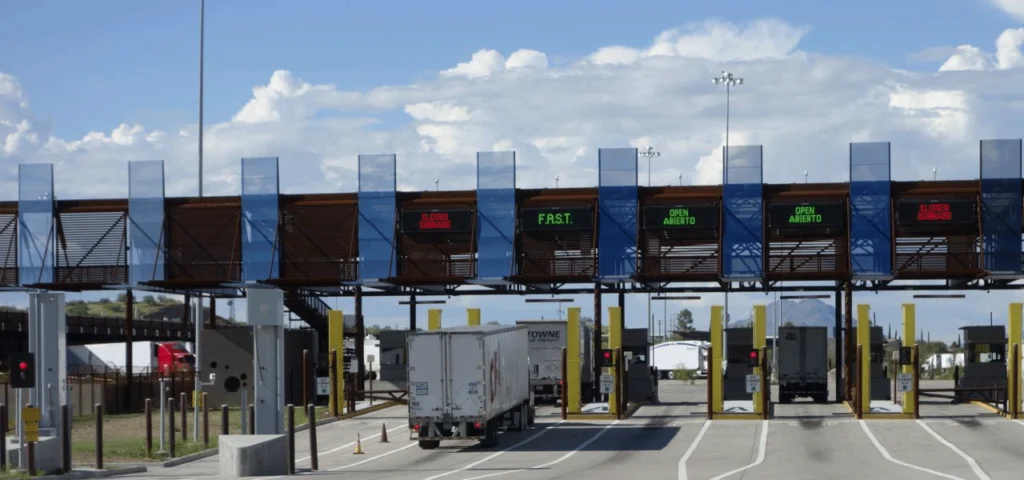
The Nogales crossings accounted for $10.8 billion in U.S. exports to Mexico and $23.3 billion in U.S. imports from Mexico.
In total, more than $34 billion in trade depended on Nogales.
Nogales Crossings
Josh Rubin, president of the Port of Santa Cruz County and Greater Nogales, believes that maintaining tariff-free bilateral trade under the USMCA is essential to sustaining these mutually beneficial relationships.
However, for border communities like this one, the promise of trade agreements is only as strong as the infrastructure that supports them.
In Rubin’s words, Nogales may be a small community of about 20,000 people—48,000 in all of Santa Cruz County—but its impact on North American trade is anything but small.
In 2024 alone, Nogales served as the gateway for more than 404,000 trucks, 3.7 million cars, 978 trains, and 10.8 million people crossing north into the United States.
Shared production
The USMCA was built on the success of NAFTA, addressing previous weaknesses and incorporating key modernizations. One statistic clearly illustrates why nearshoring is so relevant: for every dollar spent on goods from China, less than three cents return to the United States.
In contrast, for every dollar spent in Mexico, 40 cents return to the United States. This means that greater integration with Mexico directly benefits American workers, suppliers, and communities.
Rubin stated that his county supports ongoing efforts to strengthen the enforcement of rules of origin to ensure that benefits are reserved for companies truly committed to producing and investing in North America.
Recently, Mexico’s ambassador to the United States, Esteban Moctezuma, affirmed Mexico’s intention to expand its purchase of U.S. products. This commitment aligns perfectly with the objectives of the USMCA.
A clear example is Lucid Motors, whose vehicles are designed and manufactured in Arizona, while some components are sourced from the nearby state of Sonora, Mexico. This type of vertical integration creates jobs on both sides of the border and keeps a greater proportion of each trade dollar circulating within North America.
For Rubin, the USMCA has proven its value, but the next stage must focus on effective implementation, infrastructure, and investment. The goal should be to ensure that trade benefits those who produce, grow, and invest in North America, not those who exploit it from outside.