
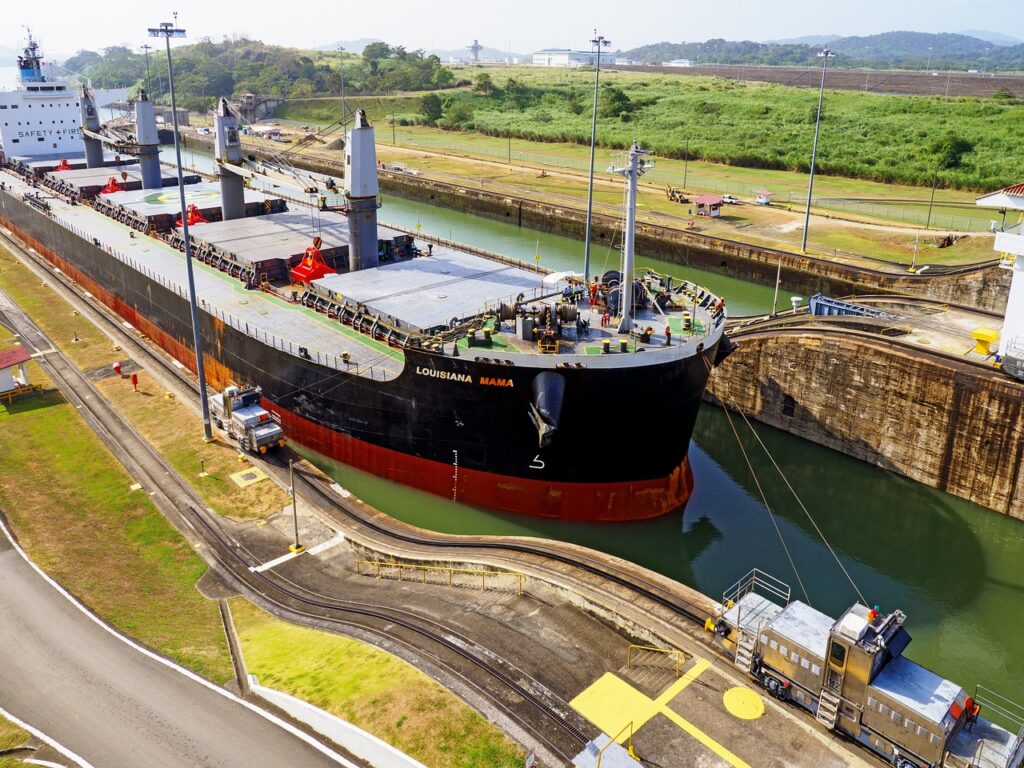
The Panamanian government is promoting decarbonization with Net Zero Quota, a program operating in the Panama Canal.
One of the biggest challenges facing maritime transport is moving towards decarbonization. To this end, in September 2025, the Panama Canal Authority launched the Net Zero Quota program. The initiative seeks to boost energy efficiency and promote the use of low-emission fuels in Neopanamax vessels.
Decarbonization with Net Zero Quota
During the first 11 months of the Panama Canal’s 2024-2025 fiscal year, which ends on September 30, 2025, 11,019 ships transited the canal. Of that total, 72.4% were Panamax vessels. The remaining 27.6% were Neopanamax.
In this context, the Panama Canal Authority indicated that, as of October 3, 2025, program participants will be able to access a weekly preferential quota. The mechanism operates through the transit reservation system. It also guarantees passage within 24 hours, just-in-time arrival service, and the option to exchange or replace vessels.
According to a report by ECLAC, in its first phase, the program will be open to ships with dual-fuel engines. These are vessels capable of operating with energies whose carbon intensity, measured under the “well-to-wake” approach, is equal to or less than 75 gCO₂e/MJ.
These energies include liquefied natural gas, liquefied petroleum gas, methanol, and ammonia. The measure thus seeks to recognize early investments in low-carbon technologies.
Panama Canal
The Net Zero Quota program is part of the Panama Canal’s sustainability strategy. The goal is clear: to achieve net zero emissions by 2050. In this way, the canal reinforces its long-term climate agenda.
The initiative complements the efforts of the International Maritime Organization. In particular, those related to the development of a sustainable fuel certification system. This mechanism will standardize the measurement of greenhouse gas intensity used by ships.
With this system, the canal will be able to verify the suitability of vessels interested in programs such as Net Zero Quota. This strengthens its role as a laboratory for environmental innovation in global maritime trade.
At the same time, the economy showed greater dynamism. In the six months ending June 30, 2025, estimated GDP growth was 4.4%. A year earlier, it had been 2.0%.
The transportation, storage, and mail sector was one of the main drivers. In the same period, it grew by around 18.9% compared to 2024. The sector contributed 13.9% of GDP, driven by increased operations in the Panama Canal and greater dynamism in air transport.